How to Intermittent Fast on a 10 PM–6 AM Shift (Without Destroying Your Energy)
"Most fasting guides assume you sleep from 10 PM to 6 AM — not work through it. Here's how to flip a 16:8 or 14:10 window to fit an overnight shift, avoid the 3 AM digestion slump, and handle transition days without falling apart
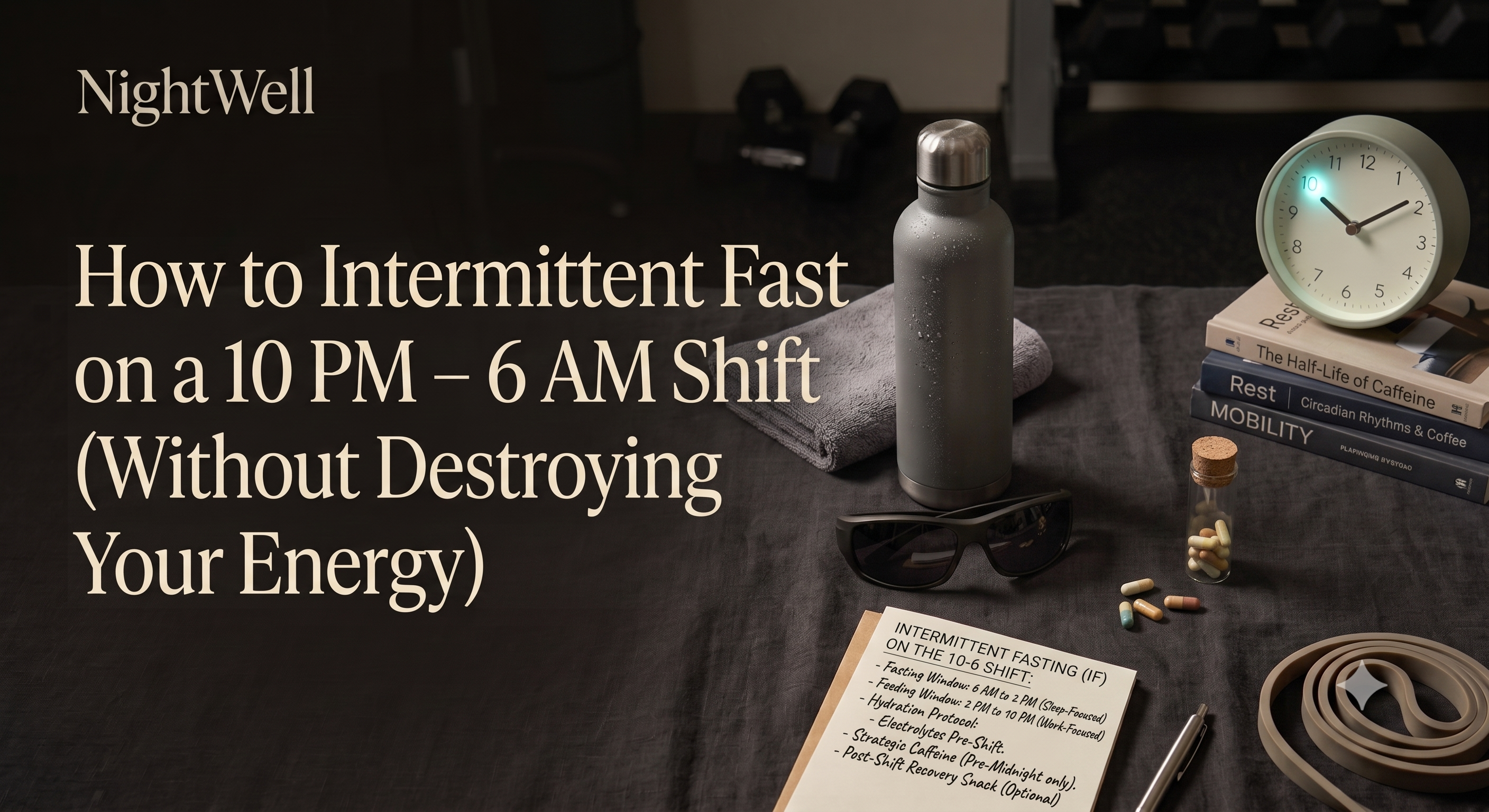
The first time I tried intermittent fasting, I followed a guide almost exactly — 16:8, eat between noon and 8 PM, fast the rest of the time. It's solid advice. For someone who sleeps at night.
I clock in at 10 PM. By the time that guide wanted me "fasting," I was three hours into my shift, running on nothing, watching the clock crawl toward 3 AM with my stomach growling and my energy in the floor. I'd break my fast the second I got home just to feel human again, then pass out for a nap-quality sleep instead of real rest. It took me a while to realize the problem wasn't intermittent fasting — it was that every guide I found assumed I slept when the sun went down like a normal person.
So I flipped it. And it actually worked.
The Windows That Work for a 10 PM–6 AM Shift
Once I stopped trying to force a daytime eating window onto a nighttime schedule, the math got a lot simpler. Here's what I landed on, and what I've seen work for others on similar shifts:
16:8 version:
Eating window: 5 PM to 1 AM
Fasting window: 1 AM to 5 PM
14:10 version (a little more forgiving):
Eating window: 3 PM to 1 AM
Fasting window: 1 AM to 3 PM
Both versions put your last meal a few hours into your shift, not right before it and not after you get home. That timing is the whole trick.
Why the Second Half of Your Shift Should Be a Fast, Not a Meal
Here's what I didn't expect: eating in the back half of my shift, around 3 or 4 AM, was actually making things worse, not better. Your digestion slows down overnight along with everything else your body does — it's not just sleep that follows a circadian rhythm. Eating a full meal at 3 AM meant I was asking my body to digest at the exact time it's biologically trying to wind down. I'd feel sluggish and foggy for the rest of the shift, like all my energy went to my stomach instead of staying awake.
Once I moved my last meal earlier — before 1 AM instead of after — that 3 AM slump mostly disappeared. I wasn't asking my body to do two hard things at once anymore.
Transition Days Are Where This Falls Apart (If You Let It)
The hardest part of this whole system was never the regular shift nights — it was the days I flipped back to a normal schedule for a day off, or transitioned onto or off a stretch of shifts. I used to just abandon the whole eating window on those days and eat whenever, which meant I spent every transition day feeling off, and it took me a night or two to get back into rhythm.
What's worked better: on a transition day, shift your eating window by 2-3 hours instead of scrapping it entirely. If I'm coming off a run of night shifts and sleeping that night instead of during the day, I'll shift my window earlier — say, 1 PM to 9 PM instead of 5 PM to 1 AM — rather than trying to snap straight back to a "normal" daytime schedule in one day. It's a lot gentler on your body, and it means you're not starting your next stretch of shifts already running on empty.
What I Wish Someone Had Told Me Sooner
Every fasting guide I found in the beginning made me feel like I was doing it wrong, because none of them accounted for a schedule like mine. The truth is the framework works fine on nights — you just have to flip which hours you call "morning" and "evening" for your own body. Once I stopped trying to force my schedule into someone else's window, this stopped feeling like a fight.
Want to build your own eating window based on your actual shift times? I put together a free Schedule Builder on NightWell that does the math for you.
Join the NightWell Newsletter
Night shift tips, healthy recipes, sleep advice, meal plans, and weekly wellness delivered to your inbox.
Comments
Be the first to comment.
Sign in to leave a comment.